
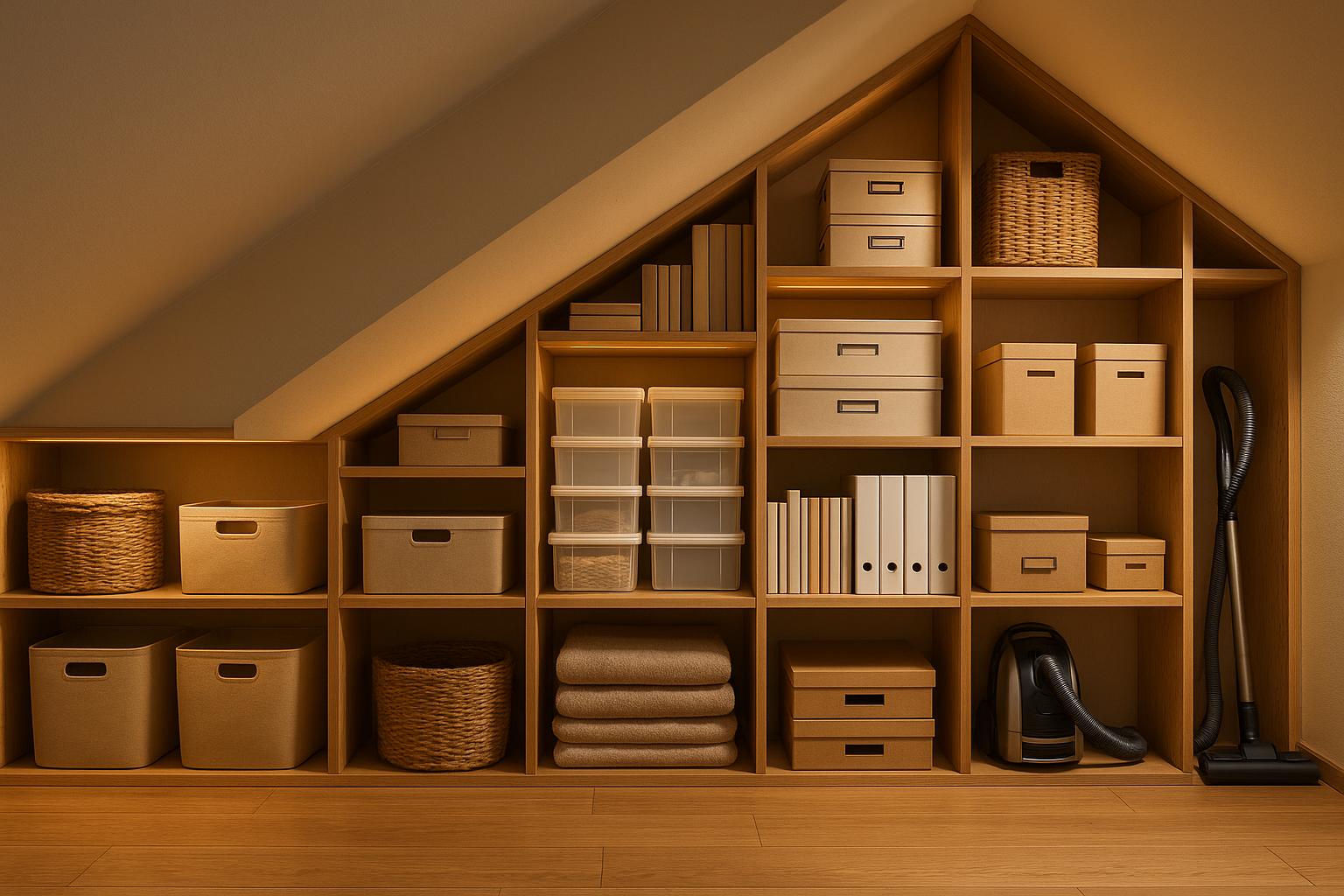
Quick answer: Under eaves storage makes practical use of the awkward, sloped space found in loft conversions and upper floors, but getting the design right requires careful planning around access and structural considerations. Done well, it turns otherwise wasted space into genuinely useful storage.
Contents
- What Makes Under Eaves Space So Tricky?
- What Storage Solutions Work Best Here?
- What Should You Consider Before Installing?
- When Does External Storage Make More Sense?
- Frequently Asked Questions
The sloped, awkward space under a roofline is often overlooked, but good under eaves storage design can turn this dead space into genuinely useful storage. Understanding what makes this area tricky, and how to work with it, helps you make the most of an often-wasted part of the home.
Knowing when built-in solutions work well, and when external storage makes more sense, helps you plan realistically.
What Makes Under Eaves Space So Tricky?
The sloped ceiling that defines eaves space means headroom decreases sharply towards the edges, making standard shelving or cupboards impractical without careful custom design. Access can also be awkward, particularly for space tucked behind low walls or accessed only through small hatches.
Despite these challenges, the sheer volume of space typically available under eaves makes it well worth the effort to use properly rather than leaving it empty.
What Storage Solutions Work Best Here?
Custom-built units designed specifically to follow the roofline make far better use of available space than standard furniture, which often doesn’t fit the sloped ceiling properly. Pull-out drawers and low-profile storage suit the reduced headroom near the edges, while taller items can be stored closer to the centre where height allows.
Built-in lighting is also worth considering, since eaves storage areas are often naturally darker than the rest of a room.
What Should You Consider Before Installing?
Checking that any planned storage doesn’t interfere with roof insulation or ventilation is important, since eaves spaces often play a genuine role in a property’s insulation and ventilation strategy. It’s also worth confirming loft or eaves flooring can safely bear the weight of whatever you plan to store.
Getting professional advice for anything beyond simple shelving helps ensure the finished storage is both structurally sound and genuinely practical to use.
When Does External Storage Make More Sense?
For items you need to access regularly, or when eaves access is genuinely too awkward to use comfortably, external self storage can be a more practical alternative than forcing everything into a difficult space. This is particularly worth considering for bulkier items that would be genuinely impractical to manoeuvre in and out of a low eaves space.
A combination approach, using eaves space for lighter, less-frequently accessed items and external storage for everything else, often works best in practice.
Frequently Asked Questions
Can under eaves storage be added without professional help?
Simple shelving can often be a DIY project, but more substantial built-in storage, particularly anything affecting insulation or structural elements, is generally worth professional installation. This helps ensure the finished result is both safe and genuinely functional.
Does eaves storage affect a property’s energy efficiency?
It can, if insulation or ventilation is disrupted during installation, so it’s worth ensuring any storage work doesn’t compromise these existing systems. Getting professional advice helps avoid this unintended consequence.
What items are best suited to eaves storage versus external storage?
Lighter, less-frequently accessed items like seasonal decorations or spare bedding tend to suit eaves storage well, while bulkier or regularly used items may be more practical in external storage. Matching the storage type to the item helps avoid frustration later.