
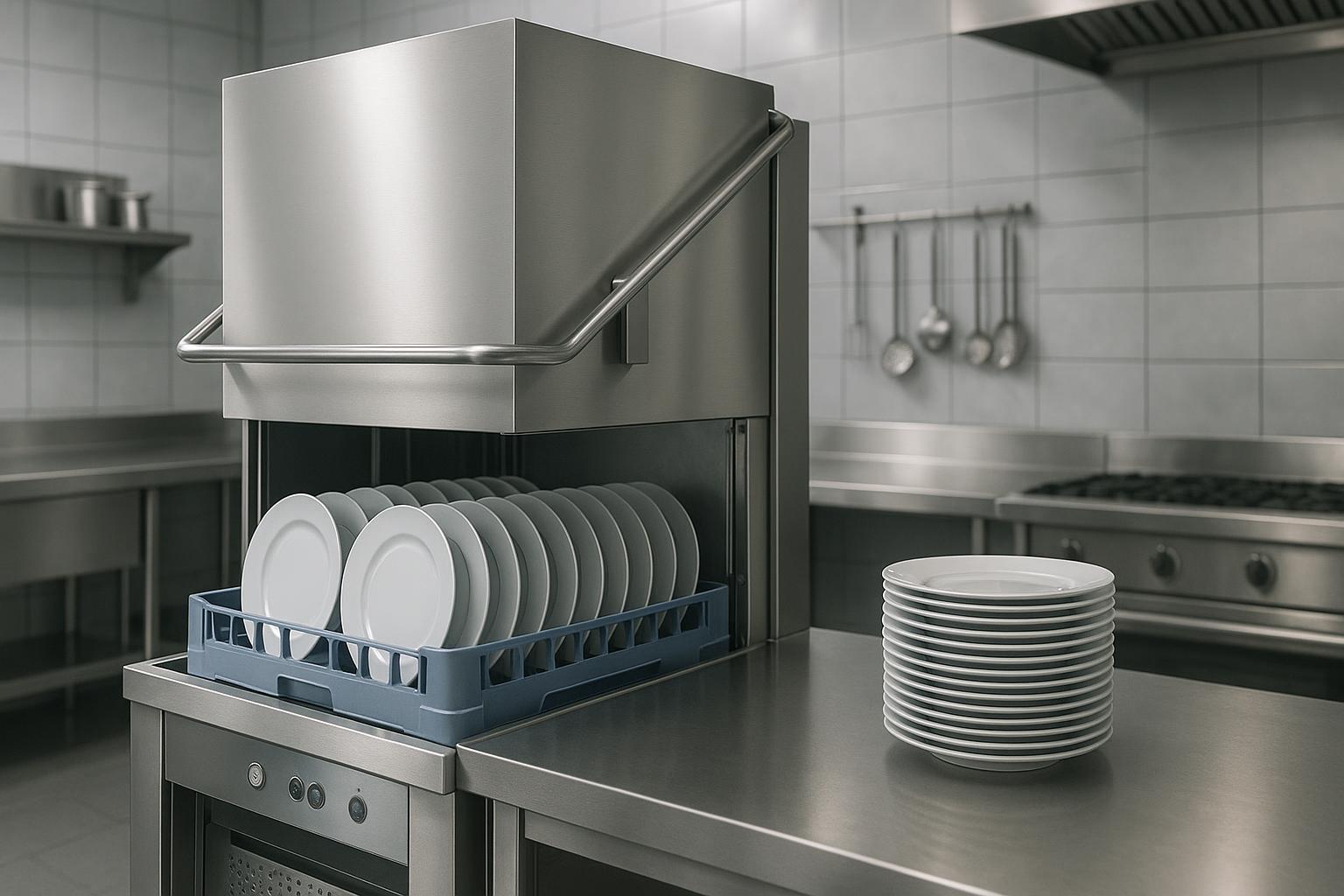
Quick answer: Commercial dishwasher price depends heavily on capacity, cycle speed and build quality, with genuine running costs over the machine’s lifetime often mattering more than the upfront purchase price. Comparing total cost of ownership, not just the sticker price, leads to a better long-term decision.
Contents
- What Affects Commercial Dishwasher Price the Most?
- How Do Running Costs Compare Between Models?
- Is It Worth Paying More for a Premium Model?
- What Should You Check Before Buying?
- Frequently Asked Questions
For any commercial kitchen, understanding what genuinely drives commercial dishwasher price helps you budget realistically and avoid being swayed purely by the lowest upfront number. A cheaper machine isn’t always the better long-term investment once running costs are factored in.
Knowing what to compare beyond the sticker price makes choosing the right machine considerably more straightforward.
What Affects Commercial Dishwasher Price the Most?
Capacity and cycle speed are major price drivers, since a machine capable of handling higher volumes in shorter cycle times naturally commands a higher price than a smaller, slower unit. Build quality, particularly stainless steel construction and componentry, also affects price, reflecting the machine’s expected working life under commercial demands.
Additional features, like built-in water softening or specific hygiene certifications, can add further cost but may be genuinely necessary depending on your specific kitchen’s requirements.
How Do Running Costs Compare Between Models?
Water and energy consumption per cycle varies considerably between models, and this difference compounds significantly given how many cycles a commercial kitchen runs daily. A slightly more expensive, more efficient machine can genuinely pay for itself over a few years through lower utility costs.
Detergent and rinse aid consumption also varies by machine design, adding another ongoing cost worth factoring into your total comparison.
Is It Worth Paying More for a Premium Model?
For high-volume kitchens, a premium model’s faster cycle times and greater reliability often justify the higher upfront cost through reduced downtime and labour costs. For lower-volume operations, a solid mid-range model may deliver perfectly adequate performance without the premium price tag.
Matching the machine’s genuine capability to your actual volume, rather than simply buying the most expensive available option, tends to produce the best value outcome.
What Should You Check Before Buying?
Confirming warranty length and the availability of local service support is worth doing before purchase, since downtime in a commercial kitchen has real, immediate cost. It’s also worth checking installation requirements, like water supply and drainage specifications, to avoid unexpected additional costs during setup.
Getting quotes for a couple of comparable models, including running cost estimates, gives a much clearer picture of genuine value than comparing purchase price alone.
Frequently Asked Questions
Are commercial dishwashers significantly more expensive to run than domestic ones?
Commercial models are generally designed for high-volume efficiency, so per-cycle costs are often lower than a domestic machine, even though the machine itself costs more upfront. The higher purchase price reflects durability and capacity built for commercial demands.
How long should a commercial dishwasher typically last?
With proper maintenance, a good-quality commercial dishwasher can last many years, though this varies by usage volume and build quality. Regular servicing and using the machine within its rated capacity both help maximise its working life.
Is leasing a commercial dishwasher a viable alternative to buying?
Yes, leasing can be a sensible option for businesses wanting to manage cash flow or avoid a large upfront cost, though total cost over time may be higher than outright purchase. It’s worth comparing both options against your specific business circumstances.